What does it take to lead a sales team?
- Sell
- Recruit
- Build the training
- Run the training
- Do the roleplays
- Coach the new ones
- Set the daily standard
- Track the numbers
- Check in with everyone
- Hold the standard
- Set the comp plan
- Watch the money
- Plan the meeting
- Keep up the recognition
- Keep belief up
- Run the contest
- Create the culture
- Do the one-on-ones
- Take care of the leaders
- Run the cadence
- Listen for what's not working
- Stay compliant
- Decide on the bottom third
- Plan the trip
- Take care of yourself
- +16 more
That's the job. It's too much for one person.
Spend time leading people. Let us take care of the rest.
Saleserator is where all of it lives. Sal makes sure nothing slips.
The AI operating system for commission sales teams. The live board, the training, scored practice calls, the weekly meeting built for you, the coaching, the contests, the first ninety days for every new hire, and Sal: a sales leader inside your team who has already read this morning's numbers. Sal is an AI assistant, not a person, and can make mistakes.
One dollar a day per personNo card to startOffice, remote, or bothCancel anytime
Free growth calculator for your team, further down↓- SalMorning. Fourteen on the team, twelve on pace. Two people are worth a call today.
The whole job
How we help.
Recruit
- Every hire lands on a ninety-day runway, milestone by milestone.
- Training, daily targets, and the board are waiting for them on day one.
- The runway shows each new hire's next milestone, and who has fallen behind.
Train
- A complete course for salespeople and a complete course for leaders.
- Upload your playbook and it becomes lessons, drills, and scenarios.
- Scored practice calls against a customer who pushes back (The Pit), and thirty-second objection drills (The Drill).
Track
- Activities logged in five seconds from a phone.
- Daily targets, a morning check-in, and an evening check-in.
- The live board on the office TV and in every pocket.
Coach
- Sal names who slipped, on what, since when, with the evidence.
- The opening for the conversation, drafted before your one-on-one.
- Command Center sorts the whole team every morning.
Retain
- Progress they can see: streaks, ranks, and My Mirror, their own page.
- The weekly meeting (The Huddle) built for you, every Friday.
- A reason to come back tomorrow, built into the day.
Culture
- Wins said out loud, on the wall.
- The whole team watching one board, in one room or three states apart.
- Wins post to your Slack channel as they happen.
Compete
- Contests from a template or your own rules, with the prize and the dates on the wall.
- Points, streaks, and ranks, with a week that resets Monday.
Reward
- Recognition with the reason attached, from you or from the team.
- Contest prizes on the board where everyone can see them.
- Every close takes over the screen for eight seconds, with the name and the number.
What changes the behavior
Even the professionals who know exactly what to do struggle to do it every day. Accountability is a habit, and habits are built by attention on the work itself, not just the result. A morning check-in with the day's targets. Activity logged as it happens. An evening check-in that closes the day. A leader who can see the work the same day, not the result a month later. That attention changes what a salesperson does tomorrow, and the results follow the behavior.
Everything on that list has a place.
The list from the top of the page, and where each part of it lives. Sal keeps all of it moving.
The board
Activity in five seconds, points, streaks, ranks, the wall on the TV.
Command Center
Who's on pace, who went quiet, who needs you, and what to say.
Training
A complete course for salespeople and a complete course for leaders. Upload your own playbook and it becomes lessons, drills, and scenarios.
The Pit and The Drill
Practice calls against a customer who pushes back, scored, with one fix per round. Objection drills in thirty seconds.
The Huddle
Your weekly team meeting, built from the week: wins, numbers, new faces, what's next.
Contests
Start one from a template, or build your own: the rules, the prize, the dates, the wall.
The runway
Every new hire's first ninety days, milestone by milestone, with the first win on the calendar.
Wins and Social
Every win on the wall as it happens, and the team's own community. Wins post to your Slack channel as they happen.
Sal
The sales leader inside the app. The brief before a conversation, drafted: who, what slipped, since when, and what to open with.
Leaders and levels
Managers, admins, and the org chart, with every leader's team in one view.
All of it, in one place.
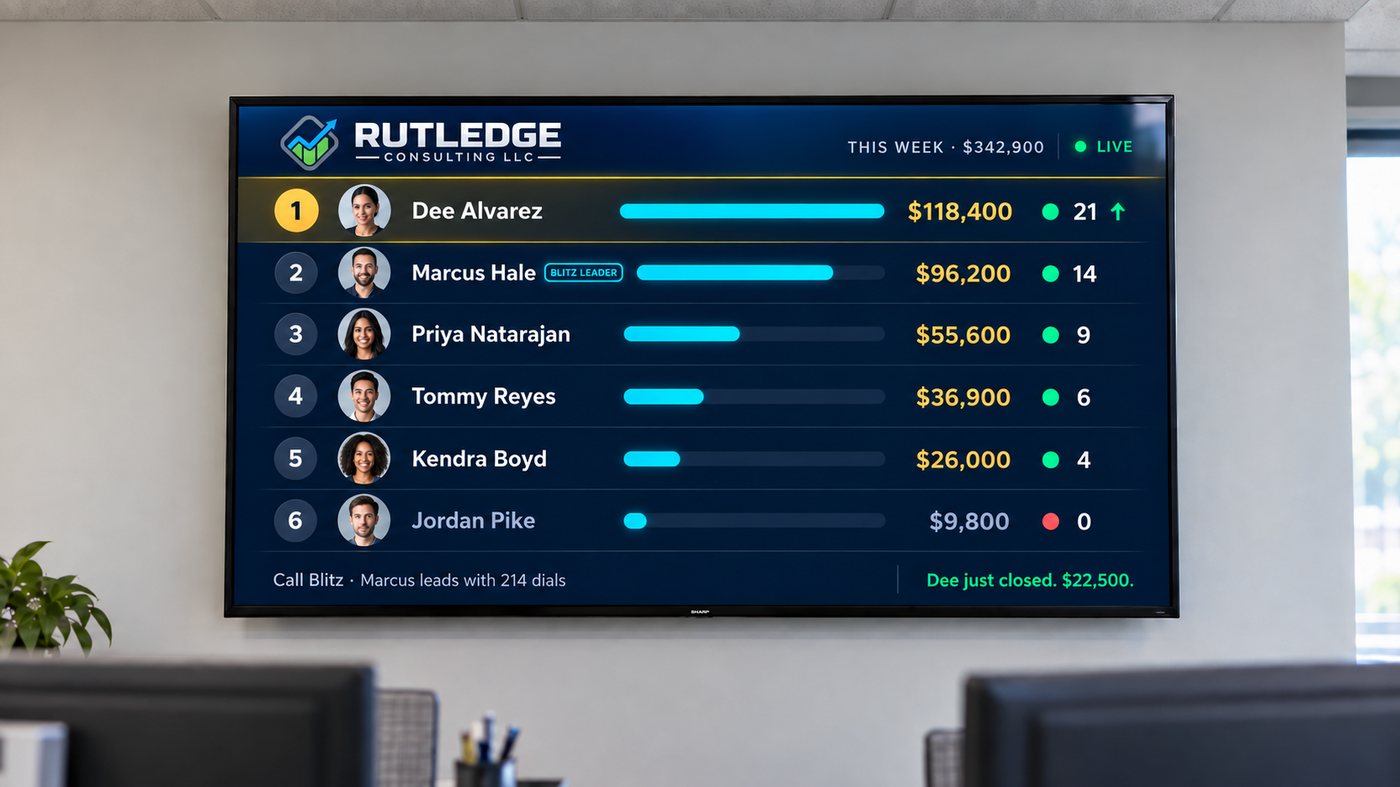
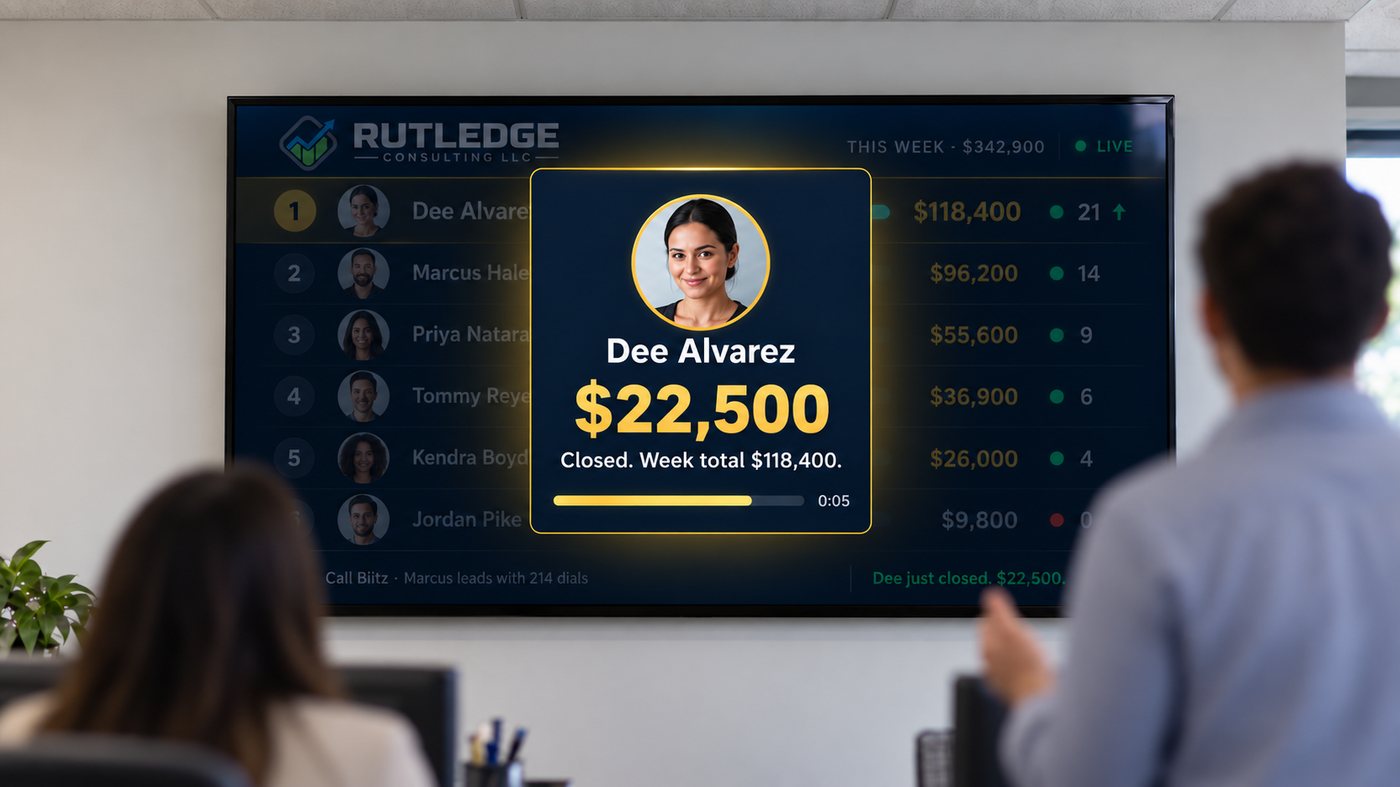
The board
On the office TV and in every pocket.
Volume, points, streaks, ranks, and the contest of the week, on the office TV and in every salesperson's pocket. The whole team watches the same board, in the same room or three states apart, and the week resets Monday.
- Log an activity in five seconds from a phone
- The board on any TV with one link
- A close takes over the screen for eight seconds, then the board comes back
A good week
Your team, on the board, winning.
The leader's screen and the team's wins, from one good week. The work is visible, the wins go up as they happen, and nobody has to ask how it's going.
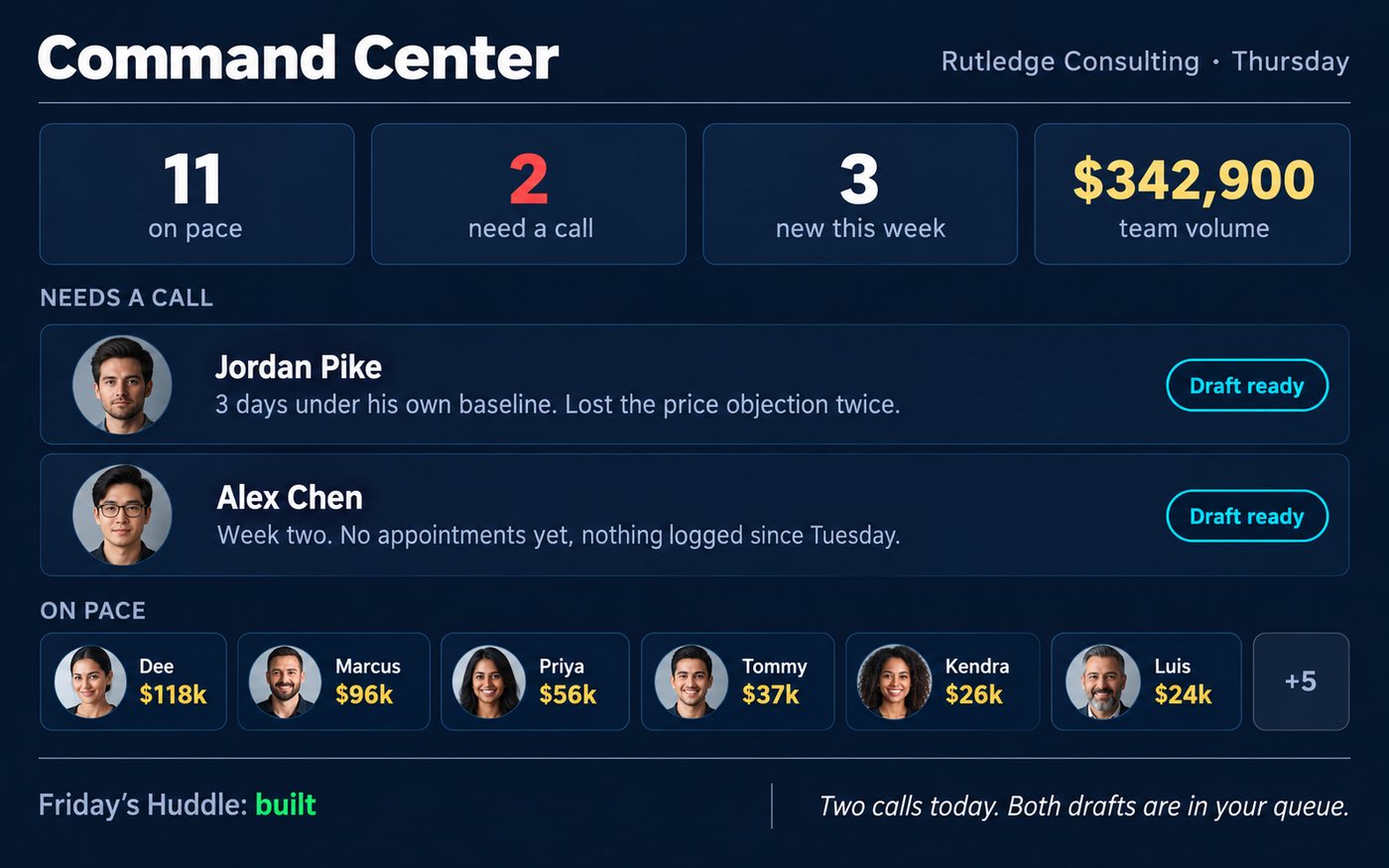
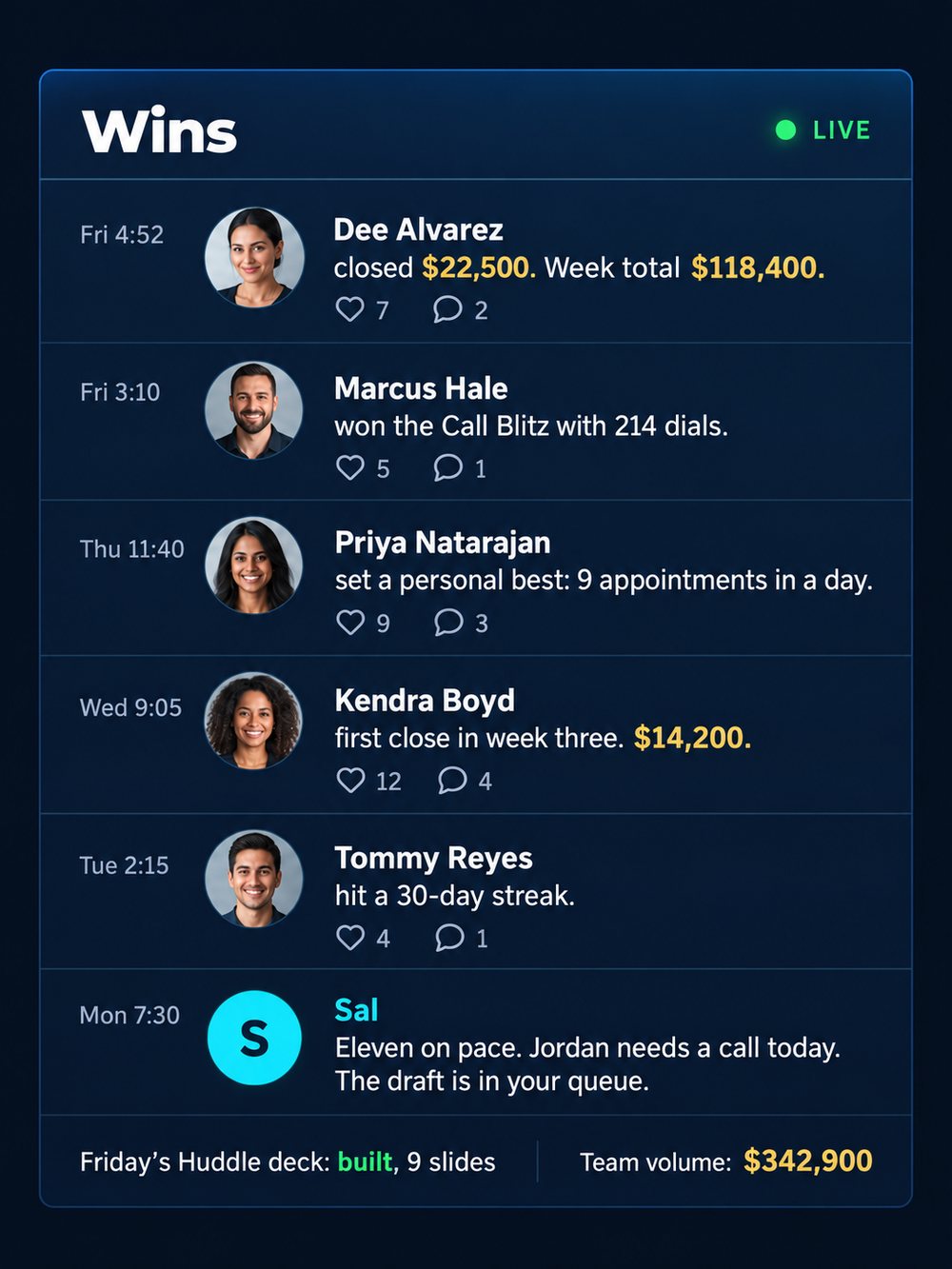
Wins post to your Slack channel as they happen.
Keep the Slack you already have. Every close and every goal hit lands in your wins channel the moment it happens.
Built around your team. Not a template.
Your industry, your products, your words, your numbers, your playbook. The more your team puts in, the more Sal knows about how your team works, and the product itself gets better every week without you doing anything.
- Your words and your numbersLeads called, appointments or sits, premium or revenue. Name the activities, add your own, decide what each one is worth and what a good day is. The whole app speaks your team's language.
- Your playbook, your scenariosUpload your scripts and objections. They become the training modules and the practice calls, so your people rehearse your product against your customers, not a generic one.
- Sal works from your team, not a scriptEvery answer Sal gives comes from your team's live numbers and your activity rules. The more history your team builds, the more precisely he can say who slipped, on what, and what to do about it.
- It never stops improvingWe ship improvements most days, and they land in your account with no upgrade and no migration. As the models behind Sal get better, Sal gets better. You never buy version two.
- Your brandYour logo and colors on the wall and in the app your team opens every morning.
- Your rules, your rateTurn features on or off per team. Change targets, contests, and rhythms any time.
Pricing
No tiers, no contract. Fourteen days free with no card.
- The board: the live leaderboard on the office TV and every phone, with points, streaks, and contests
- Command Center: the leader's morning screen, who needs a call and why, with the conversation drafted
- Sal: the sales leader inside the app, who reads the numbers and makes changes with your approval
- Training: a complete course for salespeople, one for leaders, and your own playbook turned into lessons
- The Pit and The Drill: scored practice calls against a customer who pushes back, and thirty-second objection drills
- The Huddle: your weekly team meeting, built from the week
- The runway: the first ninety days for every new hire, milestone by milestone
- Wins and Social: every win on the wall as it happens, and the team's own community
- Slack: wins post to your Slack channel as they happen
Your team is the investment. This protects it.
Every salesperson on your team cost you something to find, train, and feed with leads. The money is made when they stay, get good, and produce.
More new hires make it
On commission-only teams, losing half of the new hires in the first ninety days is normal. The fastest way to lose one is a long gap before the first check. The runway puts the first win on the calendar, the board shows them they belong, and you see who has fallen behind.
Fewer empty seats
A salesperson who walks out takes the recruiting cost, the training hours, the leads they were given, and the deals they were about to close. Keeping one more is worth more than a year of Saleserator for the whole team.
A culture you can see
A board everyone watches, wins said out loud, a weekly meeting people want to be in. That is what keeps a good salesperson from taking the next offer, and what makes the next one say yes.
Run your own numbers
Step one: your team as it is. You get a baseline. Step two: move the levers and see where the growth is. Nothing here is stored.
Each line is what one small move on that lever is worth over your horizon, ranked. The top one is usually the metric nobody is watching.
How it counts: producers produce for the year; people who leave and hires who make it count for about half a year; the team carries forward, so the gains compound. Saleserator follows the team at a dollar a day per person.
If you buy leads, pay for training, or spend your own hours coaching, every one of those dollars lands on a salesperson who is on pace and being coached, instead of in a spreadsheet nobody reads.
No result on this page is a promise. Leading a sales team is hard, and it is not for the faint of heart; it takes real work, real care, and leaders who serve the people they lead. We believe in what we built, and the humans are still the secret. The software is the tool that keeps everything in one place, makes sure nothing gets missed, and does the bookkeeping so leaders can lead people instead of spreadsheets. It also gives you the numbers to recognize someone for doing it right, which is hard to do when you don't have any.